Five Years of Ecosystems with Betta Botanicals: The Origin Story, and Where We Go From Here
We are marking five years with 25% off site-wide through Tannin Tuesday 7/28/26. No code needed. Automatically applied at checkout.
The first botanicals that sparked my fascination were surprisingly not for use in an aquarium. They were in salmon-bearing streams of Whatcom County near California Creek and Skookum, snagged in submerged stumps and root balls, covered in macroinvertebrates, bacteria, and fungi.

I was reading a research paper at the time on how upland deciduous leaf litter feeds macroinvertebrate populations in small forested headwater streams, and how those populations feed juvenile salmon downstream. I was using it as supporting evidence in a grant that would allow us to purchase lands along those two creeks which provided cold water into rivers with unfortunately high temperatures.
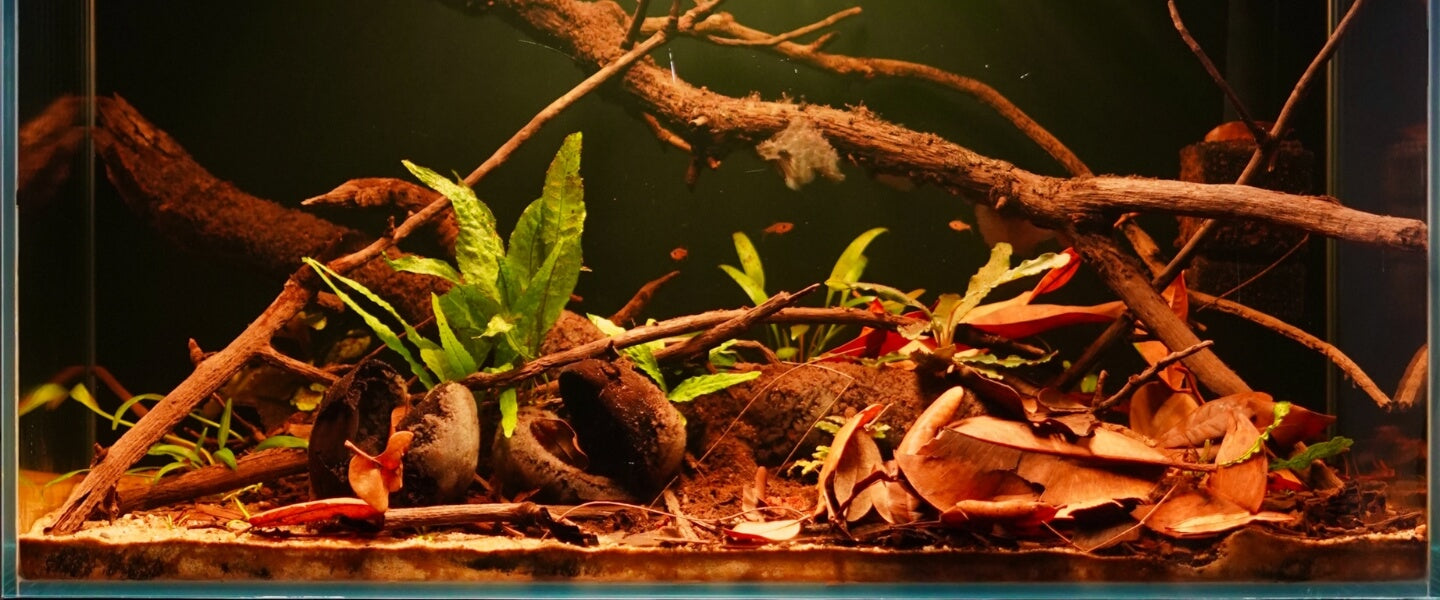
The process of an alder leaf or maple leaf turning into macroinvertebrates for salmon is a little complex, or similar to what we see playing out in the aquarium. A leaf that lands in a stream is not appetizing... yet! The same goes in the aquarium. Aquatic fungi need to first colonize it, but that only takes a few days, and within a few days after that colonization, shredding invertebrates find it worth eating. What the shredders break apart, leave behind, and consume feeds the next level of the food web. If that sounds familiar, it should. It is the same sequence you watch play out on a jambolan leaf or alder cone in your Botanical Method Aquarium.
Researchers tested this by excluding leaf litter from a headwater stream for three years. Invertebrate abundance and biomass fell across most of the food web, and the effect carried all the way up to predators (Wallace et al. 1997, Science).
This is the big idea, and it happens in tropical streams where our favorite aquarium fish are found. Everything Betta Botanicals has done for five years sits on Nature's foundation of the food web.
Betta Botanicals turned five on July 1st, and I want to highlight some of our big successes from the last 5 years, a bit on the origin story, and what I am building toward next in our Botanical Community.
How did Betta Botanicals Start?
My grandfather taught science and outdoor education. Visiting him on the East Coast meant dip nets and fishing rods and a lot of wading in streams, followed by hours of work in the garage with jars of scuds, water boatmen, daphnia, tadpoles, and a few juvenile catfish. We put them under a stereoscope, pulled out the field guides, and figured out what we had.

As a child in those New England streams, I observed, identified, and then learned. This grew further as I began my aquatics journey at the age of 5, learning to observe Nature, recreate it at home in the aquarium, then obsess over the life that shows up.
That fascination with the interconnectedness of nature eventually led to a degree in environmental science at Western Washington University, an environmental education internship at Padilla Bay National Estuarine Research Reserve, and work with Whatcom Land Trust conserving wetlands and old-growth forests as part of salmon restoration. While working on the grants to secure funding for California Creek and Skookum, I wondered if the leaf litter in salmon habitat could be used in the aquarium. Uhm, YES!

I came into this tinted aquarium niche through Johnny Ciotti and Scott Fellman and their ambassador @aquaristicarts in Sweden. Tannin Aquatics had already done the hard part in curating the language, vocabulary, the philosophy, and most of the early thinking about botanicals in aquariums came from Scott. I started out as one of his ambassadors focused on content curation on TikTok, Fishtok!!
What I could not get past was the plastic packaging.
We were curating materials whose entire value is that they break down. Every one of those botanical materials arrived sealed in plastic that would outlast the aquarium it went into, and probably (it did in fact) the shop that sold it.
Given my environmental degree, the plastic didn't sit with me well. If a material breaks down in nature, and it breaks down in the aquarium, then the thing it ships in should break down too. At the time, I did not have a business idea so much as a contradiction in values.
Then one TikTok post did what a small content creator can only hope for, and a very small operation became a full business with employees.
Betta Botanicals was founded on July 1st, 2021, with zero outside funding. I sold floating plants out of my tanks on Etsy to fund the first order of leaf litter. The first batches of Betta Botanicals shipped in home-compostable packaging from the beginning, because there was no version of this where it did not. It cost more. It still costs more. But as an important personal standard to reduce my environmental impact, there was no question that sustainable packaging would be a pillar in Betta Botanicals.
The First Five Years of Betta Botanicals in Snapshots
Five years is a lot of time spent thinking about botanicals. It's a lot of Betta Tea bags, alder cones, and shipping labels printed. Some days are harder than others, and just recently a quote from Anne Hathaway, who is everywhere in film right now, has summed it up perfectly. "When you get a little bit tired, do you like the reason that you're tired? I'm really into the reason that I'm tired... I'll sleep eventually." The answer over the last 5 years has been YES!
Botanical Pride Packs and The Trevor Project
We released, in collaboration with Scott of Tannin Aquatics, the first Botanical Pride Pack in June 2022, and have run this fundraiser every June since. Proceeds go to The Trevor Project. As of this year, we have raised over $2,000 together with the Botanical Community.

The banner headline we landed on this year was Mother Nature Thrives on diversity, which is not a metaphor that is hard to reach for in the Botanical Method Aquarium. It is a measurable property of aquatic ecosystems. A leaf litter bed with eight species of leaf supports a broader microbial and fungal community, a longer decomposition cycle, and more grazing niches than a leaf litter bed of, say, only guava leaves (nothing against guava; they are the foundation in most of my ecosystems). The aquarium hobby is better in exactly the same way, and I want everyone who finds their way into it to feel welcome.
The #TanninBae Ambassador Program
Thirteen full-time ambassadors now, fostering ecosystems in aquariums, paludariums, and bioactive vivariums across very different conditions and sharing what they observe on social media. They venture beneath the leaves boldly, tint-spiring our community.
The program has produced sponsored blog posts, photography, and social campaigns, and all three have shaped the brand in ways I am forever grateful for.
The writing covers ground I could not have covered alone. Substrates. Biofilms. Microfauna. A bioactive paludarium for emperor newts. Sparkling gourami husbandry. Planning an aquarium, from research through inevitable loss.
Ambassador photography can be seen featured in our emails, our banners, and our product pages. Photographing a Botanical Method Aquarium well is harder than it looks, because the things you are trying to capture are dimly lit with turbid water.
The social reach has been the hardest part to wrap my brain around. Campaigns have run into the millions of views, with comment sections that would take a full day to read end to end. A good share of those comments are some version of the same question: why is the water brown? That question is the doorway or first step on this slippery slope. TANNINS.
Contests have followed. Botanical builds are taking podium spots at shows where 2 years ago they would not have been entered at all.

What I did not anticipate is how much of my own curiosity and understanding would come from reading their notes. Thirteen aquarists observing Nature's processes is a lot of data sets, botanicals going through the goo-phase, and networks of aquatic hyphomycetes.
Working with Scott Fellman, my fellow 'Pod Father'
Scott Fellman built Tannin Aquatics and writes The Tint. I started as his ambassador, and the concepts I reference — functional aesthetics, operational ecology, the goo-phase, detritus, etc. — are largely his learnings and deciphering from what happens in Nature. Anyone selling botanicals today is working inside a framework he laid down first, whether they know it or not. We went on to create a Leafy Live Series on IG with our third pod father, James of Blackwater UK, which is now run by his wife Leah, after his sudden passing in 2025.
Going from carrying someone's banner to running a company in the same space could have been awkward, but we figured it out, and it never was. Scott has been generous with me from the beginning, and the common threads from his work to mine are something I would rather tell you here than let people assume and whisper in the comment section or on reddit. A text from him just last week reads, "and seeing you take the torch literally to a new generation is so gratifying to me." More on our future collabs are discussed later.

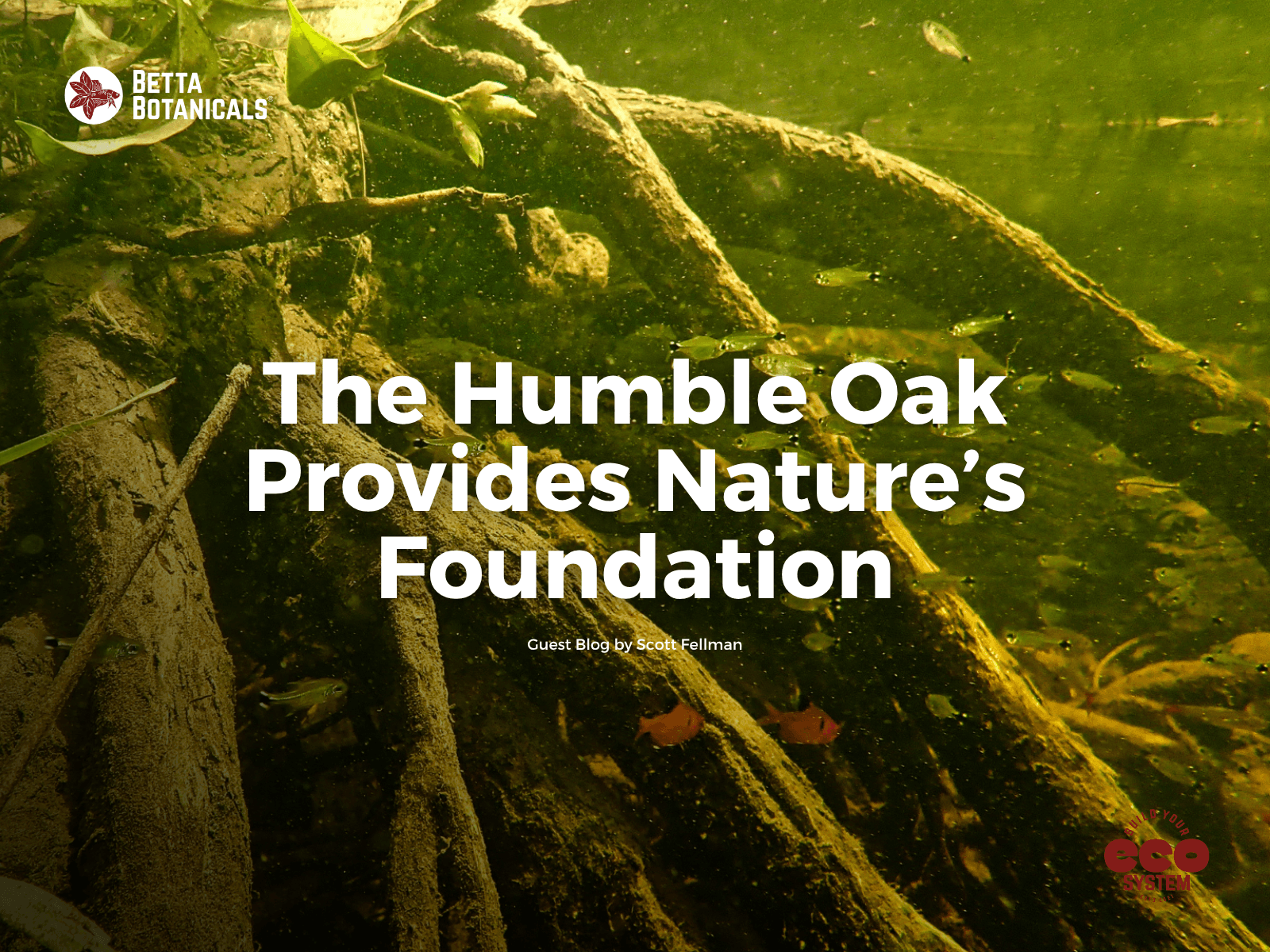
He wrote a guest post for us this year making the case for The Humble Oak. Ten years of testing the most exotic leaves available, and his favorite turned out to be the one growing in everyone's backyard. His writing covers in situ curing, what leaches out of submerged oak wood, and why the biofilm stage people find alarming is the ecosystem's proof of establishment. His writing on Ben's Aquarium Blog is the full-circle moment for the brand.
Later this year we may be bringing back a limited run of vintage Tannin Aquatics offerings. Some of those botanicals shaped how an entire corner of the hobby thinks about aquariums, and it seems right to put them back in circulation while there are aquarists who remember them and aquarists who never got the chance.
Third Place at Aquashella New Jersey, 2025
Hayley and Jack of Studio Aquatica took third in the aquascaping contest at Aquashella NJ with a blackwater aquarium. It was the first time either of them had live-scaped in front of an audience, and the first time they had collaborated on a scape. They went in with almost no pre-planning and worked from a shared understanding of the story the botanicals, the tannins, and the plants would tell.

Over 7,000 hobbyists at Aquashella walked past their scape. Competition scaping and the Botanical Method do not normally see eye-to-eye, and the allure of the BMA takes a couple months. But that weekend, in front of a crowd that size, they did. Where a botanical contributes as it breaks down, an aquatic plant is living and contributes as it grows. Kind of contradicting roads to the same destination of a functional ecosystem.
He also wrote that the Botanical Method is one of many ways to scape, and that some people love it and some people hate it. Both of those are fine by me. An approach that asks you to accept biofilm, detritus, and a long decomposition cycle was never going to be for everyone. Betta Botanicals sponsorship of this scape competition would not have been possible without Ryan N!
Calvin's Botanical Method Aquarium Feature in AMAZONAS
Calvin, one of our longest TanninBae Ambassadors, wrote and photographed Under the Leaves: An Introduction to the Botanical Method Aquarium for AMAZONAS. It ran in the January/February 2025 issue, the one with Whiptail Catfishes on the cover, pages 56 through 64. Nine pages of images, laying out the whole method for the readership of one of the most well-known magazines in the aquarium hobby. I was fortunate enough to find a copy at Aquarium Zen, who has been my longest-running wholesale partner.

His writing explains the methods in an approachable way, featuring the brand, which I have, of course, wanted to see in print since the brand's inception in 2021. It separates blackwater, biotope, and Botanical Method cleanly instead of using the three interchangeably. It covers collection ethics, preparation, the substrate ratios he works with, and why detritus from decomposing botanicals behaves differently in an aquarium than waste-based (food and fish poop) detritus does.

The article closes by pointing readers to The Tint. Calvin sends them to Scott, Scott sent me down this road years ago, and a magazine article now interlinks the three of us on the same page. Full circle!
Sponsoring How to Create an Organic Aquarium
Oliver Jamieson's How to Create an Organic Aquarium: The Beginner's Guide to Soil-Based Freshwater Aquariums, sponsored by Betta Botanicals alongside API.

Soil-based aquariums sit right next to the Botanical Method, and I often refer to Diana Walstad's book Ecology of the Planted Aquarium as my bible of choice. Oliver's guide shares much the same admiration of her work. When compared to the Botanical Method Aquarium it's a slightly different input, same principle: let soil, plants, and microbes handle the filtration instead of buying equipment that does it for you. Oliver walks a beginner through water chemistry without getting too deep in the weeds on the science, and closes with an illustrated field guide to more than forty species. Our #TanninBae Ambassador Brandy (@brandys_bettas) keeps a soil-based aquarium for Betta hendra, and her photography carries our own guide to dirted Botanical Method aquariums.
Expanding the Wholesale Shelf Across North America
It's not easy for me to summarize the gratitude I have for my wholesale partners. They put Betta Botanicals in front of people who would never have found my website or social campaigns. They allow people to physically hold the compostable bags of leaves, turn them over, and read them before deciding. And they let Botanical Method hobbyists skip a shipping charge and transit via the post office.

They have also changed how we curate our selection. Selling direct means I can explain a material at length on a product page, with as many words as it needs. A shelf gives you none of that. A bag of catappa has to make sense to someone who picked it up on the way to the register, and to the staff member who has about ninety seconds to answer their question. That constraint pushed us toward clearer labeling, the product cards, and the preparation guidance we now write specifically for retail staff. Most of that came back around and improved what direct customers receive too.
Supporting our local economies of fish stores is quite important to me, as the local fish stores I visited in Seattle as a teen (Aquarium Zen included!) provided the education or bouncing-off points that I needed at the time. Having this wholesale program that provides my natural botanical materials to local aquarists is really a dream come true.
One Fry from the King, Betta macrostoma
Betta macrostoma is a paternal mouthbrooder from the clear water hill stream habitats of Borneo, and it is famously polarizing in having a pair unwilling to cooperate, or one that breeds the first time successfully. Males abort broods under stress. The sound of a vacuum. Water parameters that look fine on paper are not fine. People keep them for years without a single viable brood.
I got one fry!!
You can see the video here on my Insta
I am aware of how that reads. But a single fry means the water chemistry was (close) to optimal, the male stayed committed through the full 18-day incubation, and the habitat gave him enough cover to feel secure and escape from his wife. That is the entire argument for the Botanical Method Aquarium. The leaf litter, the tannins, the Java Jungle, the microfauna waiting in the detritus for something tiny to start eating — all facets of what they needed finally collided together.
I have never been prouder of a number that low.
Hiring Emma and Faye as the first Employees of Betta Botanicals
For most of five years, Betta Botanicals was just me in the spare bedroom of our apartment or garage sorting leaves by hand, with the help of countless people offering business advice for free or helping me during holidays when two loads of orders had to be delivered to USPS in the Mazda. But no additional hands for the day to day. This year it became three.

Emma and Faye came on as the first employees, and oh my goodness I can't imagine a world where BB functions without their help. How was I doing all that before?
What I did not expect is how much hiring would sharpen the business. The standards I had been carrying around in my head — product descriptions, which pods get rejected, how a leaf should look before it goes in our compostable pouches — had to become formal processes. Writing them down made them better. Most of what we ship now passes through hands other than mine, and it is more consistent for it. I look back just to last year and think to myself how on earth I was packing orders and skus by hand as they came in, whereas now there are pull trays with 12-24 skus already prepackaged. How'd I do it?!
Where is Betta Botanicals Going with All this Momentum?
We are venturing further beneath the leaves. Resources are in the pipeline that get quite scientific, paired with beginner guides and maybe even a book.
Somewhere to put all of the Ecosystem Supplies. The garage is full. It's a game of Tetris. Enough people have taken up the Botanical Method Aquarium that our first full ocean container imports are now underway from our collectors, and the botanicals en route will fill my garage floor to ceiling, so... A warehouse, or storage containers on the lawn are being figured out!
The SABTP partnership. Ben (his name is also Ben) and I have been in discussion for the last several months to get his non-profit off the ground. The Sustainable Aquarium Botanical Trade Project is a program of Parosphromenus Indonesia, a registered Indonesian non-profit working on Parosphromenus conservation in peat swamp habitat. We are finalizing an agreement to bring their materials into the United States: Macaranga, Campnosperma, Calophyllum, Tristaniopsis merguensis, Dicranopteris linearis, Daemonorops, Pteridium, and Casuarina. A donation of each pack sold will be made directly to Parosphromenus Indonesia to help support the conservation of habitat where these fish can be found.
A printed handbook. A beginner-to-intermediate guide to the Botanical Method Aquarium, in print. Ben's Aquarium Blog and The Tint have covered most of it in pieces over five years, and with our online Guide to Establish and Maintain a Botanical Method Aquarium. And, it deserves to exist on everyone's coffee tables.

Blackwater Variety Packs for South America and Southeast Asia. Two are in development. Igapó, for the seasonally flooded blackwater forests along Amazonian rivers; and Gambut, for the peat swamps of Borneo and Sumatra, which have battery acid water of very, very low pHs. Each pack will be assembled as Biotope-inspired materials familiar to the fish who call those places home.

An Isopod and Shrimp Variety Pack. Freshwater shrimp and terrestrial isopods graze the same way on the same materials, just on opposite sides of the waterline. There are select leaves and pods that are higher in supplemental nutrition, vitamins and trace minerals that will be blended together for their benefits. One selection will serve both.

The vintage Tannin Aquatics products, described above, could include their prior line of NatureBase Substrates alongside our house blends for use in the Botanical Method, blackwater, and biotope aquarium.
Five Years of Watching Things Decompose and the Life that Grows Out of the Detritus
The thing I did not expect about running this company is how little the core methods have changed. Leaves fall in. Fungi and microbes colonize their surfaces. Detritus accumulates. Animals graze, shelter, and spawn in the habitat that results. Patience is key. However, my/our understanding of Nature's network of beneficial microbes has expanded. Observe. Identify. Learn. Remember?
Five years ago I was teaching via Tiktok why the water was brown and that it wasn't bad. Now I get emails from aquarists tracking their third year on the same undisturbed substrate, describing the shifts in the ecology that even I have not observed yet. One fry from the macrostoma brood because a lot of small ecological decisions lined up correctly, and that is the same thing happening at a different scale for the brand.
My learning about the Botanical Method Aquarium (and how to run a responsible business) has not stopped. I hope yours never does either.
We are marking five years with 25% off site-wide through Tannin Tuesday on 7/28/26. No code needed. If you have been meaning to re-leaf your aquarium, this is a reasonable week to do it!
-Ben
Chief Ecosystem Officer, Betta Botanicals
Everything on Ben's Aquarium blog stays free to read. If you would like to support this work, outside of building your ecosystem, you can buy me a coffee to support future resources like this.

Inspire your friends:
Using Oak Leaves and Twigs in Our Aquariums: The Case for Generic Tropicals — A Guest Post by Scott Fellman
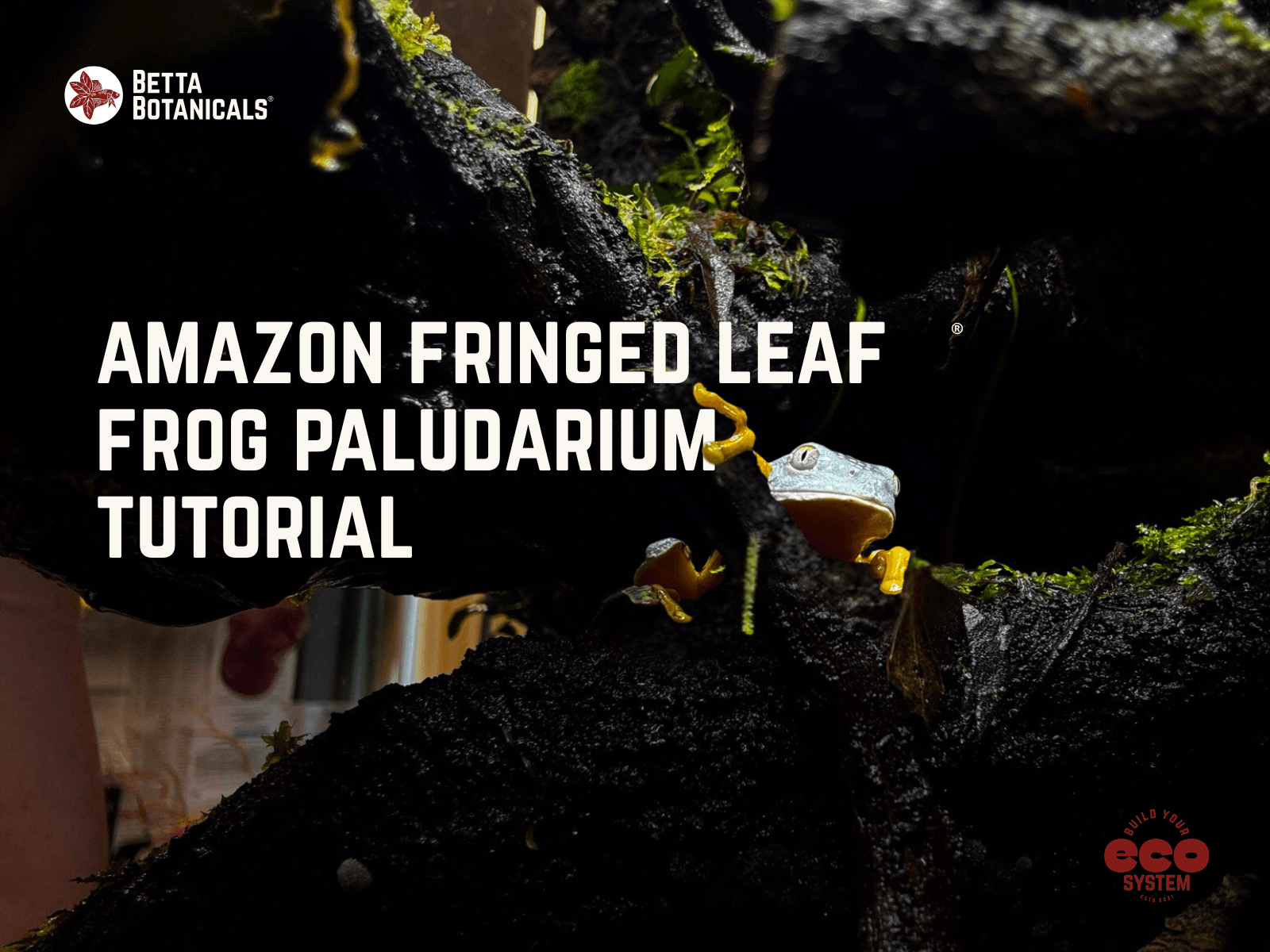
Designing a Paludarium for Amazon Fringed Leaf Frogs (Cruziohyla craspedopus)